I was seriously going to delete this article as it is completely out of date. But then I read through it and realized this was the perfect example of Moore's Law in describing how quickly hardware can be outdated. So instead I will leave this here for your amusement and enjoyment.
I didn't think my needs were that out of the ordinary. I was basically looking for a system that will allow me to do development, graphic design, desktop video, studio quality audio, DVD playback, encoding high definition formats, stream music, and run a few automation tasks for my home. Oddly enough no one puts these things together into a readily made system. The result has been that the past 4 computers that I have needed have resulted in building them myself by hand.
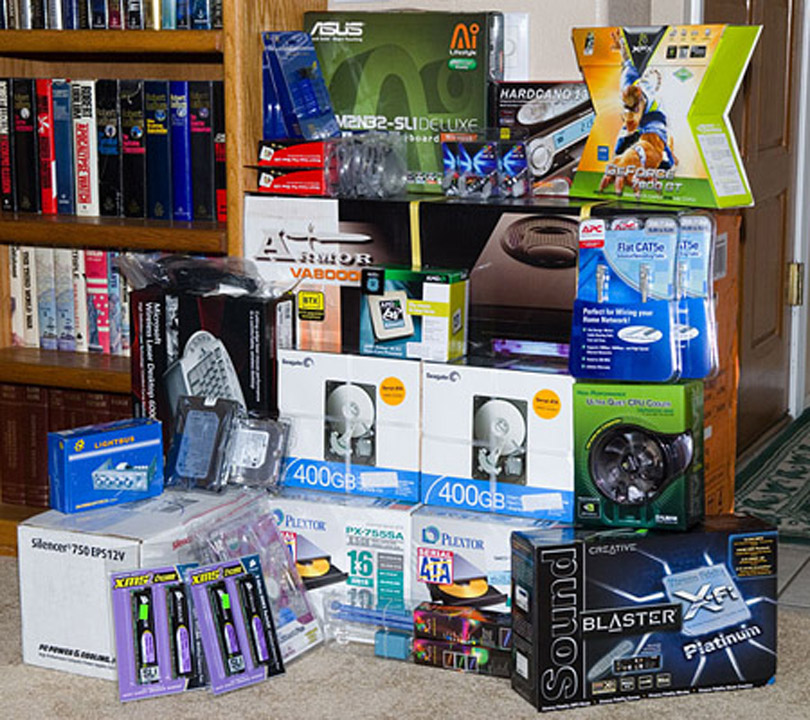 One positive aspect of this has been that I alone can choose where to compromise the design of the computer. Every system ever made has been a compromise of some sort. The manufacturer has to find a balance between performance and price for a computer to be successful in the marketplace. The problem is that as a consumer we have little say in what that compromise may be. Some manufacturers such as Dell allow configuration options but those too are limited by the decisions they make of what parts to offer. A prime example is in power supplies which are not the most sexy of components to spec. Dell has chosen to private label their power supplies meaning you are locked into their design and if your system suddenly requires more power than the stock supply can provide you are stuck having to upgrade only with Dell rather than being free to chose the best supplier for your needs. This is just one aspect of the decision-making process. I only use Dell as an example, all manufacturers do something similar with some component of their systems. By eliminating that piece I am free to determine which manufacturer to use for each component. This though also has its drawbacks. You are alone to troubleshoot any compatibility or incompatibility issues that may arise. You end up working with multiple vendors trying to solve the problem when each of them blame someone else for the issue.
A lot of people think that by building their own computer they will save a lot of money. This is sometimes or in my case all the time a fallacy. You are free to choose the trade-offs you make so if you choose price as the determining factor you may be able to build an inexpensive system but it will be limited. Because you are building a single computer, you do not gain from the economies of scale that is possible for a manufacturer that builds thousands of computers. What you do gain is the ability to choose exactly which components and which brands are specified for your specific computer. You can build the type of system that best meets your needs without having to purchase extras that a manufacturer adds onto the system. This is a hidden savings but may be different to quantify.
I've just completed a build which occurred in August 2006. I've gone from a single core processor to one of the new dual core generation chips. I've been running this system for a couple of weeks now and so far I am very impressed. The details of the system are:
- ASUS M2N32-SLI Deluxe Wireless Motherboard
- AMD Athlon X2 +4600 processor
- Zalman CNPS9500 CPU Cooler
- 4GB low latency RAM
- (2) Plextor PX-755A DVD Dual Layer Burners 16x burn of DVD+/-DL disks (SATA)
- (2) Seagate 400GB Hard Drive with Perpendicular Indexing (SATA II)
- (3) Seagate 320GB Hard Drive with Perpendicular Indexing (SATA II)
- Sound Blaster X-FI Platinum Sound Card
- XFX NVidia 7900GT 256MB Video Card
- Hardcano13 Fan Controller
- Thermaltake Armor VA8000BWA Full-size Tower Case
- (2) 120mm LED Fans
- (2) 92mm LED Fans
- (4) Meteor LED UV Light sticks
- (3) Lazer 5 LED Case Lights
- Sunbeam Light Bus (to make lights flash to the sound card or hard drive activity)
- PC Power and Cooling 750 Watt Power Supply
- Microsoft Wireless Desktop 6000 Keyboard and Mouse
- Dell 2405FPW 24" LCD Widescreen Monitor
- (2) Gigabit Ethernet Connections (networking in parallel)
The system is performing flawlessly and when compared to the single core processor Intel Pentium 4 2.8GHz it is amazing. I had really wanted to build an Intel Core Duo system but the motherboard manufacturers did not have an SLI board with the nVidia 590 chip set available nor could anyone give me a timeline of when these may be available. This along with the competitive pricing of the AMD processors led my decision. Hopefully this system will allow me to work more effectively for a while until the next cool thing comes out. If you have questions about the computer systems I have built or would like to talk about creating your own computer, please contact me and I would be happy to help you.
 Back
Back